
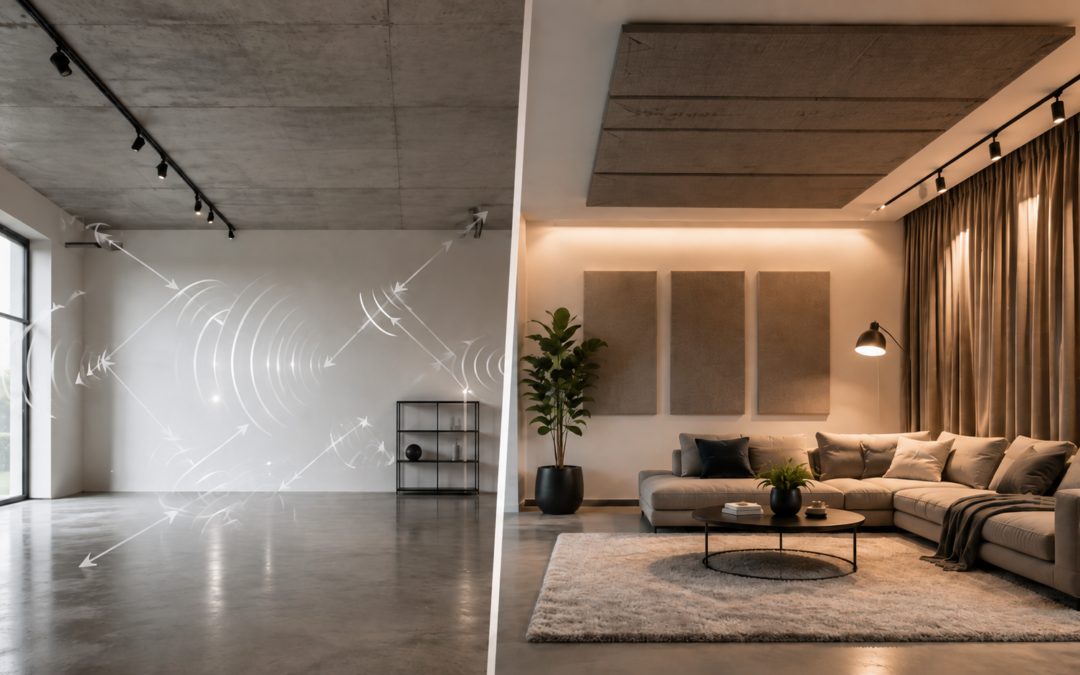
A room can be modern and high-quality in its furnishings yet still have an unpleasant echo. Conversations feel exhausting, voices are hard to understand, and music sounds imprecise or too loud. This problem often occurs in new flats, offices, restaurants, or open living areas.
But why does echo occur at all? And what can be done about it without completely renovating the room?
In this article, we will show the five most common causes of echo and explain how simple measures can quickly improve room acoustics.
What is echo in a room?
When speaking, listening to music, or watching television, sound waves are generated. These spread throughout the room and hit walls, floors, ceilings, windows, furniture, and other objects.
Some of the sound is absorbed by the surfaces. Another part is reflected back into the room. When many reflections reach the ear in quick succession, the sound remains audible for longer. This effect is known as reverberation.
A certain amount of reverberation is normal and necessary. Without reflections, a room would sound unnatural and 'dead'. However, if the reverberation time becomes too long, speech intelligibility deteriorates. Sounds overlap, and the room feels loud, restless, and uncomfortable.
1. Too many hard surfaces
The most common cause of echo is large, hard, and smooth surfaces. These include:
- Concrete walls
- Tiles and natural stone
- Parquet or laminate
- Glass surfaces
- Smooth ceilings
- Large tabletops
- Flat cupboard fronts
These materials absorb very little sound. Instead, they reflect a large part of the sound energy back into the room.
The combination of tiled floors, large windows, and bare walls is particularly problematic. In such a room, sound can bounce back and forth multiple times between the various surfaces.
Quick remedies
Textile materials can noticeably improve room acoustics. Suitable options include:
- a large rug
- carpets
- upholstered furniture
- fabric roller blinds
- wall hangings
- textile room dividers
These measures primarily reduce reflections in the mid and high frequency ranges. However, in cases of strong echo, rugs and curtains alone are often insufficient. In this case, additional acoustic absorbers are advisable.
2. The room is too sparsely furnished
Minimalistic rooms often appear visually elegant but are acoustically problematic. Few pieces of furniture, bare walls, and large open spaces offer little resistance to sound.
This is particularly noticeable in an unfurnished flat. Even a normal conversation produces a distinctly audible echo.
Furniture, shelves, plants, and decorations can partially scatter or absorb sound. The emptier a room is, the longer the sound energy remains within it.
Quick remedies
The room does not need to be completely filled. Just a few targeted changes can help:
- a filled bookshelf against a bare wall
- a sofa or upholstered armchairs
- larger plants
- open shelves
- cushions and textile decorations
- furniture with different shapes and depths
Particularly filled bookshelves can help distribute sound more irregularly throughout the room. Plants also support this effect but do not replace professional acoustic elements.
3. Parallel walls create strong reflections
Most rooms are rectangular. This means that walls, floors, and ceilings face each other in parallel. Sound waves can be reflected back and forth between these surfaces.
The so-called flutter echo is particularly noticeable. If you clap your hands once vigorously, you hear a quick, metallic or fluttering echo.
Typical areas for flutter echoes are:
- between two bare side walls
- between floor and ceiling
- between large window areas
- in long corridors
- in narrow meeting rooms
- between a desk and a smooth ceiling
Quick remedies
To reduce flutter echo, at least one of the opposing surfaces should be treated.
Suitable solutions include:
- Wall absorbers
- acoustic pictures
- curtains in front of large window areas
- bookshelves
- Ceiling Cloud
- acoustic panels
- diffusers for sound scattering
Often, not every wall needs to be fully treated. Just a few strategically placed absorbers can significantly reduce disruptive reflections.
4. High ceilings and large open spaces
High rooms, lofts, and open living areas have a large volume. This gives sound more space and takes longer to attenuate sufficiently.
This problem occurs particularly frequently in the following rooms:
- open living and dining areas
- gallery flats
- stairwells
- open-plan offices
- restaurants
- meeting rooms
- rooms with exposed concrete ceilings
In such rooms, treating the walls is often not enough. A large part of the sound is also reflected between the floor and the ceiling.
Quick remedies
In high ceilings, Ceiling Clouds are particularly effective. They are mounted at a distance below the ceiling and absorb a large part of the incoming sound energy.
Other options include:
- Ceiling Absorbers
- vertical acoustic baffles
- suspended acoustic ceilings
- large wall absorbers
- acoustic room dividers
Ceiling Clouds are particularly suitable above dining tables, workstations, seating areas, or meeting tables. There, they reduce disruptive reflections precisely in the areas where conversations take place.
5. Too few or incorrectly placed acoustic elements
Sometimes carpets, curtains, or individual acoustic panels are already present, yet the room still echoes.
This is often due to the fact that the elements used are:
- too small
- too thin
- only mounted in one place
- incorrectly positioned
- predominantly absorb high frequencies
- partially reflective themselves
A single small acoustic picture can hardly bring about a noticeable change in a large room. Thin felt panels or decorative wooden slats also have only a limited effect if the underlying absorption layer is too thin.
Quick remedies
Acoustic elements should be distributed as sensibly as possible throughout the room. Good positions are:
- large bare wall areas
- areas next to or behind a workstation
- the wall behind a sofa
- areas opposite large windows
- the ceiling above a table
- opposite parallel walls
- upper wall areas in high rooms
For broad-band effectiveness, sufficiently thick absorbers are recommended. Wall absorbers with a depth of about five to ten centimetres or more can absorb significantly more sound than very thin acoustic panels.
An additional gap between the absorber and the wall can further enhance effectiveness.
A simple test for too much echo
A clap test can roughly assess the acoustics of a room.
Stand approximately in the middle of the room and clap your hands once vigorously. Pay attention to how long the sound remains audible.
A long, diffuse reverberation indicates a high reverberation time. A short, metallic flutter, on the other hand, is a sign of flutter echo between parallel surfaces.
There are also typical signs of problematic room acoustics in everyday life:
- Conversations are exhausting.
- Multiple people are hard to understand.
- The television needs to be set very loud.
- Phone calls sound unpleasant.
- Music sounds blurred or imprecise.
- Noises from the kitchen or dining area dominate the entire room.
However, a clap test alone is not sufficient for an accurate assessment. A professional acoustic measurement shows how long sound lingers in different frequency ranges in the room.
What helps quickly against echo?
Those who want to improve room acoustics in the short term can start with simple measures.
A large rug reduces reflections from the floor. Heavy curtains help with large window areas. Upholstered furniture, cushions, and textile elements provide additional absorption.
However, in cases of clearly audible echo, wall absorbers and Ceiling Clouds are usually the more effective solution. They can be strategically mounted at the most important reflection surfaces and visually adapted to the room.
It is important not to treat just a small area. Absorption should be distributed as evenly as possible throughout the room.
How much acoustic treatment does a room need?
The number of absorbers or Ceiling Clouds needed depends on various factors:
- Size and height of the room
- existing materials
- number and size of windows
- Furnishings
- use of the room
- number of people
- desired acoustics
A living room requires a different acoustic tuning than a recording studio, open-plan office, or restaurant.
Too little absorption allows the room to continue sounding echoey. Too much absorption, on the other hand, can make it feel uncomfortably dry and lifeless. Good acoustic planning therefore creates a balanced relationship between absorption, reflection, and sound scattering.
Conclusion
Echo usually does not arise from a single cause but from the interplay of several factors. Hard surfaces, large windows, few pieces of furniture, parallel walls, and high ceilings can significantly prolong reverberation time.
Simple measures like rugs, curtains, and upholstered furniture often provide an initial improvement. However, for stronger reverberation, professionally planned wall absorbers and Ceiling Clouds are significantly more effective.
By specifically addressing the causes, not only does the sound of the room improve. Conversations become clearer, music sounds sharper, and the entire room feels calmer and more pleasant.