
ACOUSTIC DIFFUSERS
RTA DIFFUSION
Distributing sound purposefully. Preserving spaciousness.
RTA diffusers control the distribution of incoming sound energy in the room, rather than solely absorbing it. This helps reduce disruptive directional reflections while maintaining spaciousness, liveliness, and a natural sound feel.
— For studios, HiFi rooms, and demanding listening areas
— Different diffuser shapes and wood finishes
— Project-specific sizing and positioning
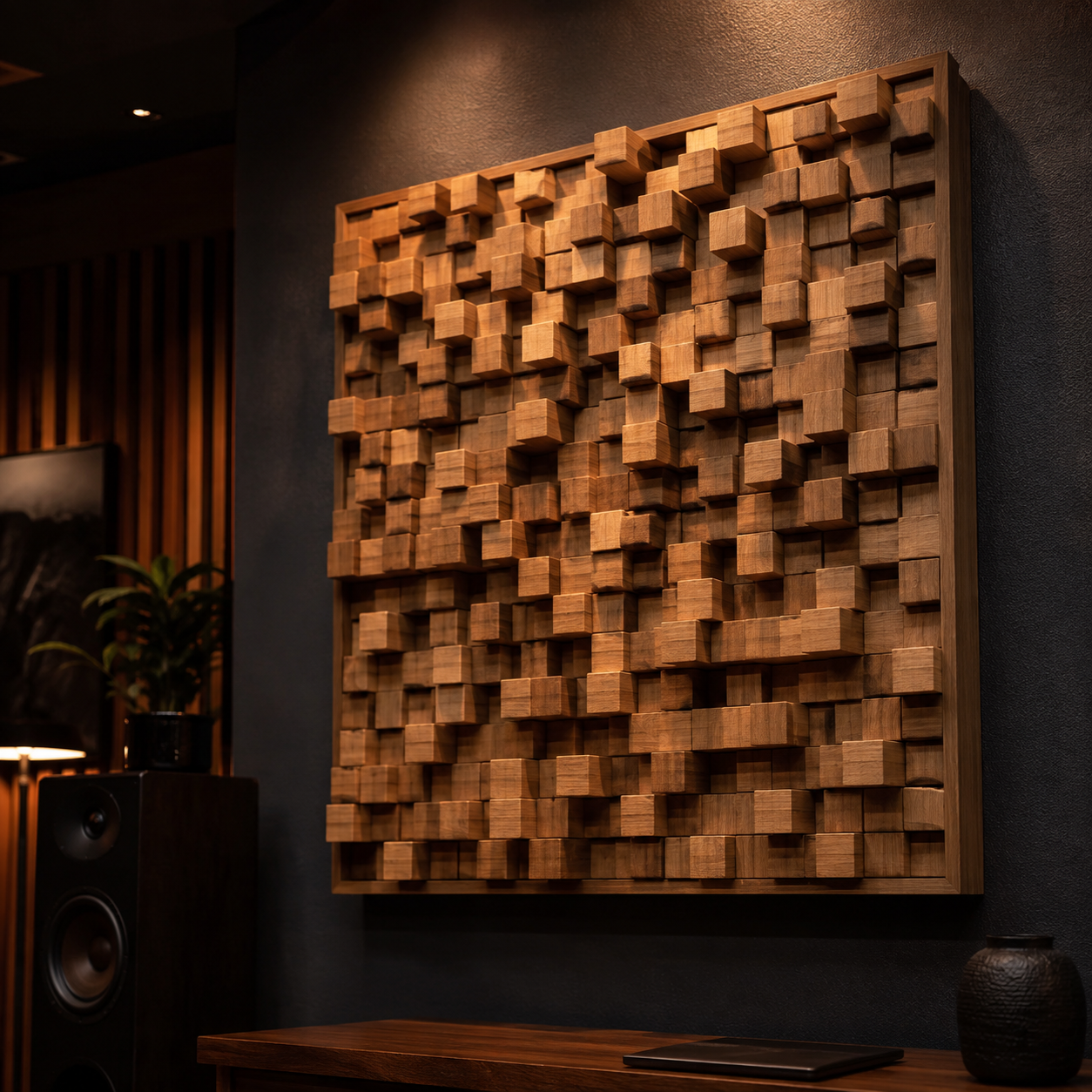
Sound distribution · high-quality wood processing
APPLICATION
Wall surfaces and selected ceiling areas
CONSTRUCTION TYPE
QRD, Skyline, and custom shapes
MATERIAL
Wood and project-specific surfaces
PLANNING
Position and distance according to room concept
CONTROLLED SOUND DISTRIBUTION
More spaciousness without disruptive directional reflections.
Diffusers break incoming sound energy spatially and temporally. In suitable positions, they can mitigate strong directional reflections without unnecessarily drying out the room through additional absorption. The right type of diffuser depends on room size, listening distance, and acoustic goals.
01
Distributing reflections spatially
Incoming sound energy is distributed in different directions. This allows individual strong reflections to be perceived as less dominant.
02
Preserving spaciousness
In contrast to additional absorption, diffusion can retain energy in the room and support a more open, vibrant sound image.
03
Expanding the listening area
A more balanced distribution of reflections can help the sound develop naturally and spatially, not just at a single point in the room.
MODELS & DIFFUSER TYPES
Different structures for different rooms.
Diffusers vary in geometry, depth, scattering direction, and design effect. The suitable construction type depends on room size, listening distance, available space, and the desired acoustic outcome.
RTA DIFFUSION QRD
QRD diffuser
One-dimensional sound distribution
A QRD diffuser works with chambers of varying depths and predominantly distributes incoming sound energy in a defined plane. It is suitable, for example, for selected rear or side wall areas.
— Clearly structured wood geometry
— Horizontal or vertical orientation
— Single module or combined area
— Project-specific sizing
RTA DIFFUSION SKYLINE
Skyline diffuser
Two-dimensional sound distribution
The differently tall wooden elements distribute sound energy in multiple directions. The striking three-dimensional surface combines acoustic function with a high-quality architectural effect.
— Multidimensional structure
— Striking spatial design
— Single module or modular system
— Different wood finishes
RTA DIFFUSION CUSTOM
Custom diffusion solution
Project-specific execution
A custom solution for special wall areas, niches, combined acoustic concepts, or diffusers intended to be integrated into architecture and furnishings.
— Custom width and height
— Adaptation to special areas
— Combination of various modules
— Project-specific mounting solution

Precise geometry · high-quality wood processing
CONSTRUCTION & MATERIALS
Precise geometry for controlled sound distribution.
The effectiveness of a diffuser is significantly determined by its geometry, depth, dimensions, and manufacturing accuracy. Therefore, structure, material, and installation are planned not only according to visual but also acoustic criteria.
01 Calculated geometry
Different chamber, block, or surface depths create a targeted spatial and temporal distribution of incoming sound energy.
02 High-quality wooden construction
Dimensionally stable wood materials allow for precise dimensions, clean surfaces, and a durable construction.
03 Precise processing
Even spacing, clean edges, and accurate depths are crucial for a high-quality visual and functional execution.
04 Secure installation preparation
Weight, dimensions, and intended position are taken into account during fastening. The mounting system is tailored to the wall structure and diffuser size.
TECHNICAL EFFECT
Breaking reflections instead of fully absorbing energy.
A diffuser has a structured surface with varying depths or heights. Incoming sound waves are not only reflected in one direction but are distributed spatially and temporally. This can mitigate strong directional reflections while retaining some of the acoustic energy in the room.
— Spatial distribution of incoming reflections
— Preservation of liveliness and sense of space
— Construction type and positioning according to room planning
The actual effect depends on diffuser geometry, construction depth, area, mounting orientation, and listening distance. Binding performance data will only be published after final product development and documented testing.
SCHEMATIC SOUND DISTRIBUTION

Schematic representation to explain the principle of operation. No tested product measurement data.
DESIGN & CUSTOMISATION
Acoustic function as a high-quality design element.
Diffusers have a pronounced three-dimensional surface and thus shape the room design. Wood type, colour tone, geometry, orientation, and module size are coordinated so that acoustic function and architectural effect match.

01
Fabrics & colours
Acoustically open fabrics are available in different shades. This allows for discreet, contrasting, or decor-matching designs.

02
Wooden frames & surfaces
Light, natural, or darker wood finishes allow for subtle integration or a conscious contrast within the room concept.
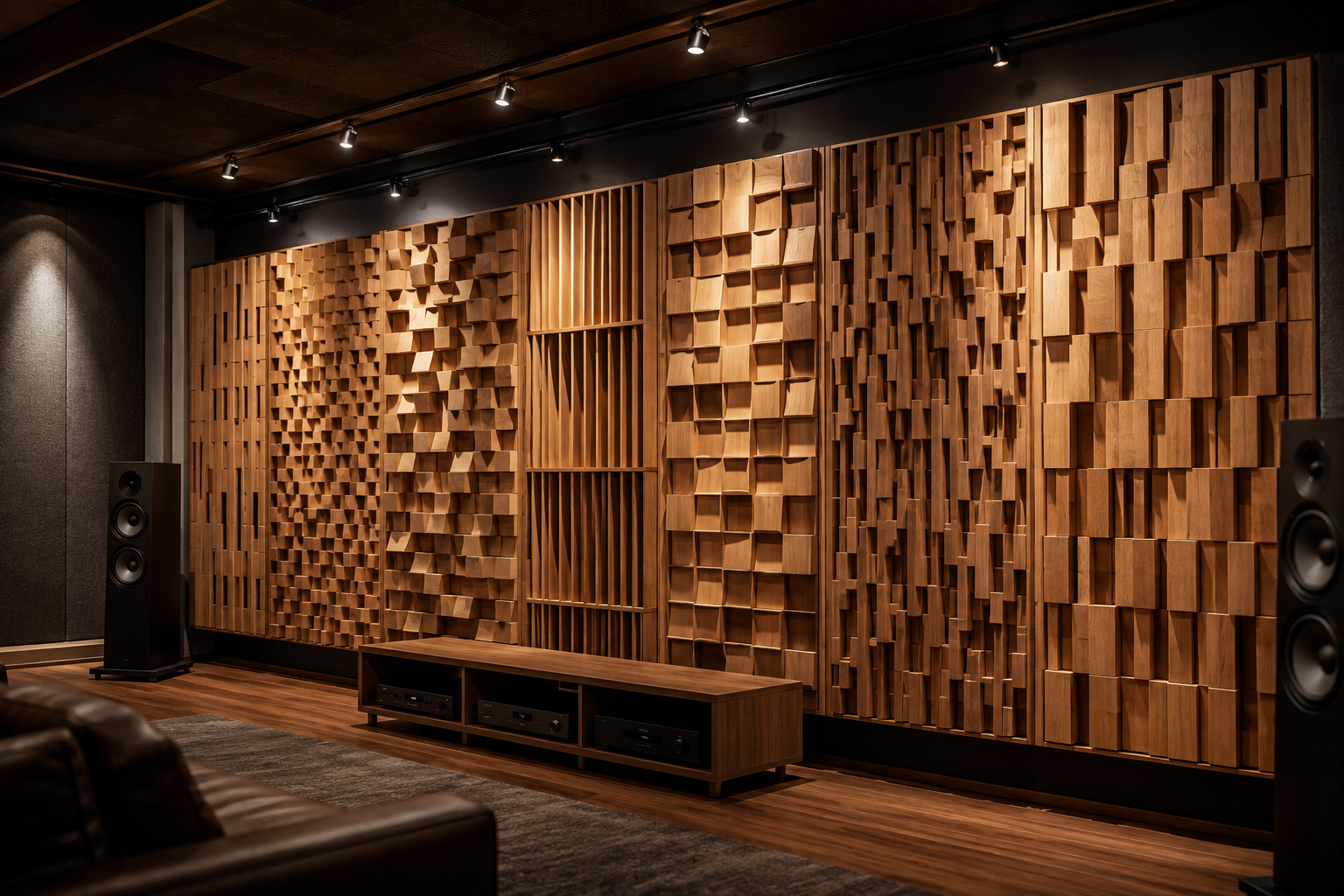
03
Custom design
Individual diffusers can be combined into larger areas and adapted to wall width, furniture, speaker positions, and architectural elements.
TYPICAL POSITIONING
Employing diffusion where it makes acoustic sense.
Diffusers are often used on rear walls, selected side wall areas, or other surfaces with disruptive directional reflections. The suitable position depends on room size, listening distance, speaker position, and existing absorption.
A diffuser requires sufficient distance from the listening position so that the scattered sound energy can develop spatially. In small rooms or at very short distances, additional absorption may be the better solution.
01
Rear Wall
Behind the listening position, diffusers can spatially distribute strong rear wall reflections while maintaining the liveliness of the room.
02
Side wall areas
On selected side wall surfaces, diffusion can be sensible if directional reflections need to be reduced without using additional absorption.
03
Behind speakers
Depending on the type of speaker, wall distance, and room concept, diffusers can also be used in areas of the front wall.
04
Larger wall areas
Multiple modules can be combined into a larger diffusion area if room size and listening distance are suitable.
FROM PLANNING TO FINISHED DIFFUSER
Geometry, surface, and position appropriately coordinated.
Before production, we check room size, available wall areas, listening distance, and existing acoustic measures. From this, we derive suitable diffuser type, dimensions, orientation, and design.
01
Analysing the room
You send us room plans, measurements, photos, and existing measurement data. If necessary, we conduct an acoustic measurement on-site.
02
Selecting the diffuser
We assess whether diffusion at the intended position is sensible and which construction type, size, and orientation suit the room.
03
Manufacturing
The diffuser is precisely manufactured with the coordinated geometry, wood surface, and installation preparation.
04
Delivery & installation
Depending on the project, our diffusers are collected, delivered, or professionally installed at the planned position.
FAQ - FREQUENTLY ASKED QUESTIONS
Questions about RTA diffusers.
Here you will find answers to diffuser types, positioning, listening distance, wood surfaces, planning, and installation.
What is the difference between absorption and diffusion?
Absorbers reduce sound energy and can decrease reflections and reverberation. Diffusers spatially and temporally distribute incoming sound energy. This retains more energy in the room while mitigating strong directional reflections.
Which type of diffuser is suitable for my room?
This depends on room size, listening distance, available space, and acoustic goals. QRD diffusers predominantly distribute sound in one plane, while skyline diffusers can allow for multidimensional scattering.
How far should the distance to the diffuser be?
The necessary listening distance depends on diffuser geometry, construction depth, and setup. A distance that is too short can lead to individual reflections or structures being perceived more strongly. Therefore, the appropriate distance is assessed on a project-specific basis.
Can a diffuser also be used in a small room?
In principle, yes, but diffusion in small rooms is not automatically the best solution. With a short listening distance or already too long reverberation time, additional absorption may be more sensible. Therefore, the position should be checked in advance.
Are different wood types and surfaces possible?
Yes. Depending on the model and project, various wood types, colour tones, and surface treatments are possible. The available options are coordinated before production.
Can a diffuser be combined with absorbers?
Yes. In many rooms, a combination of absorption and diffusion makes sense. Absorbers control reverberation and problematic reflections, while diffusers can support spaciousness and liveliness in suitable areas.
Does Rock Tribe Audio also handle the installation?
Yes. We can professionally install our own diffusers upon request. We do not install third-party products, as their weight, construction, and fastening system have not been verified by us.
Can I only commission an acoustic measurement or planning?
Yes. You can also engage Rock Tribe Audio solely for acoustic measurement, evaluation, or planning. There is no obligation to purchase the recommended diffusers from us. However, we only offer installation for our own products.
Can a diffusion area be expanded later?
Yes. Individual diffuser modules can often be added later to create a larger area. Ideally, module size, orientation, and potential expansion areas are considered during the initial planning.
DIFFUSION SUITABLE FOR YOUR ROOM
Let us plan the suitable diffusion solution.
Send us information about your room, the available wall areas, the listening distance, and the existing acoustics. We will advise you on diffuser type, dimensions, wood surface, positioning, and installation.