
PREMIUM BASS ABSORBER
RTA BASS CONTROL
Control deep frequencies. Listen more precisely.
RTA Bass Traps support the control of problematic low frequencies and long decay times. Depending on the room and acoustic objectives, we develop large-volume corner solutions, wall absorbers, or customised bass measures for studios, HiFi rooms, home cinemas, and music rooms.
— For room corners and acoustically relevant wall areas
— Different designs and dimensions
— Project-specific design and layout
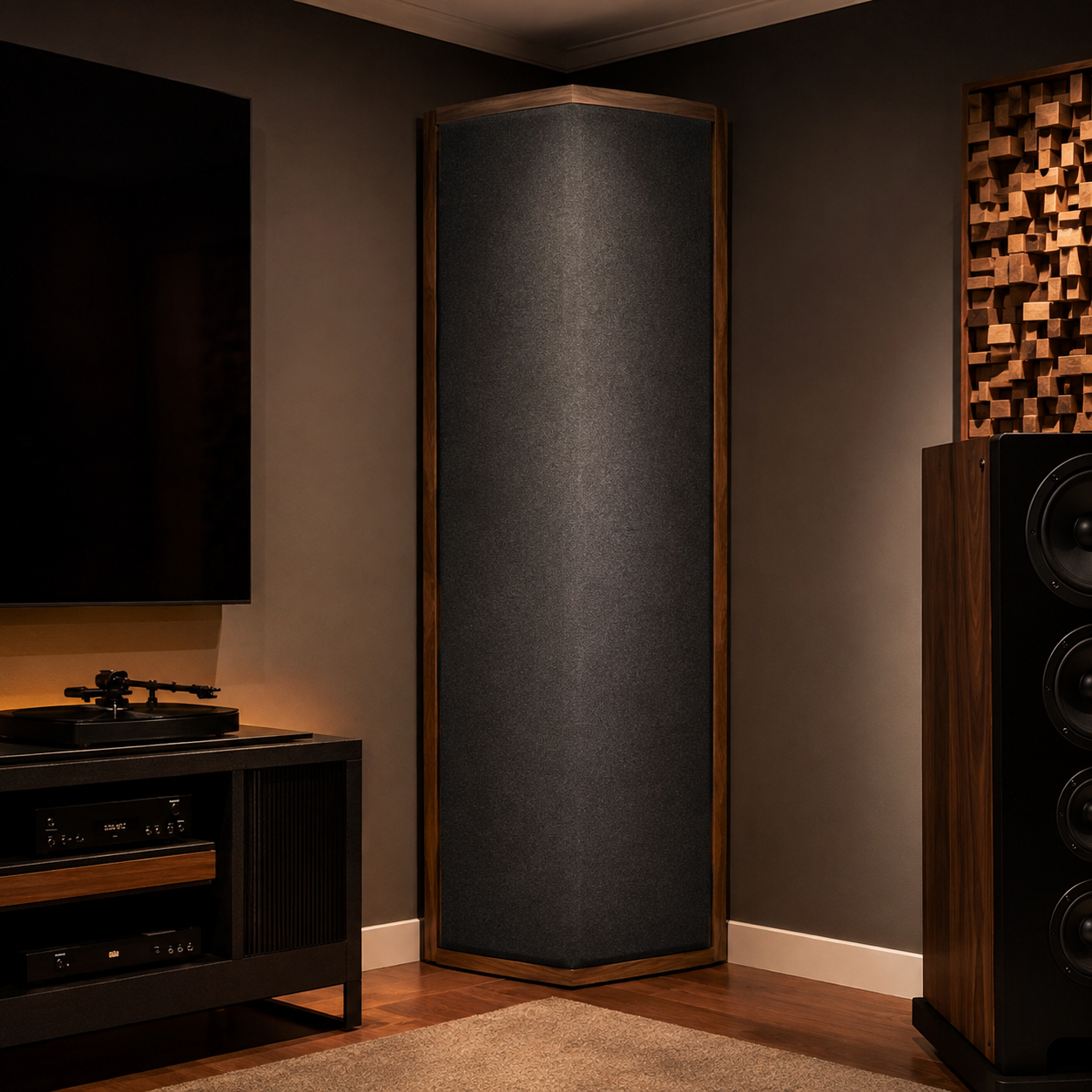
Bass control · custom execution possible
APPLICATION
Room corners and wall areas
CONSTRUCTION TYPE
Corner solution and surface absorber
EXECUTION
Standard and custom-made
MOUNTING
Floor-standing or permanently mounted
BASS CONTROL
More control in the low-frequency range.
Low frequencies are particularly influenced by room dimensions, boundary surfaces, and the position of speakers and listening positions. Suitable bass measures can reduce resonances and long decay times, thereby supporting a more controlled low-frequency reproduction.
01
Control room modes
Large-volume bass absorbers can dampen problematic resonances and reduce the overemphasis of individual low frequencies.
02
Shorten decay times
Long-decaying bass frequencies can be reduced. Bass impulses become clearer, and individual notes remain more distinguishable from one another.
03
Improve low-frequency reproduction
More controlled bass energy supports more reliable mixing decisions and a more precise music reproduction at the listening position.
MODELS & EXECUTIONS
Bass control tailored to room and application.
Bass problems vary depending on room geometry, speaker position, listening position, and intended use. Therefore, we offer various designs and tailor volume, dimensions, positioning, and layout to each project.
RTA BASS CONTROL CORNER
Corner bass trap
Project-specific dimensions
Large-volume solution for room corners where low-frequency sound energy can build up particularly strongly.
— For vertical room corners
— Large effective volume
— Single module or stacked solution
— Fabric and wood options
RTA BASS CONTROL WALL
Wall bass absorber
Project-specific dimensions
Lower-profile wall absorber for front, rear, or side walls when a corner solution is not possible or a larger contiguous area makes sense.
— For acoustically relevant wall areas
— Different depths possible
— Single module or modular system
— Wall distance as planned
RTA BASS CONTROL CUSTOM
Custom bass solution
Individual dimensions
Project-specific solution for niches, sloped ceilings, special room geometries, or bass measures to be integrated into architecture and furnishings.
— Custom width, height, and depth
— Special shapes upon review
— Integration into wall or corner areas
— Project-specific mounting solution
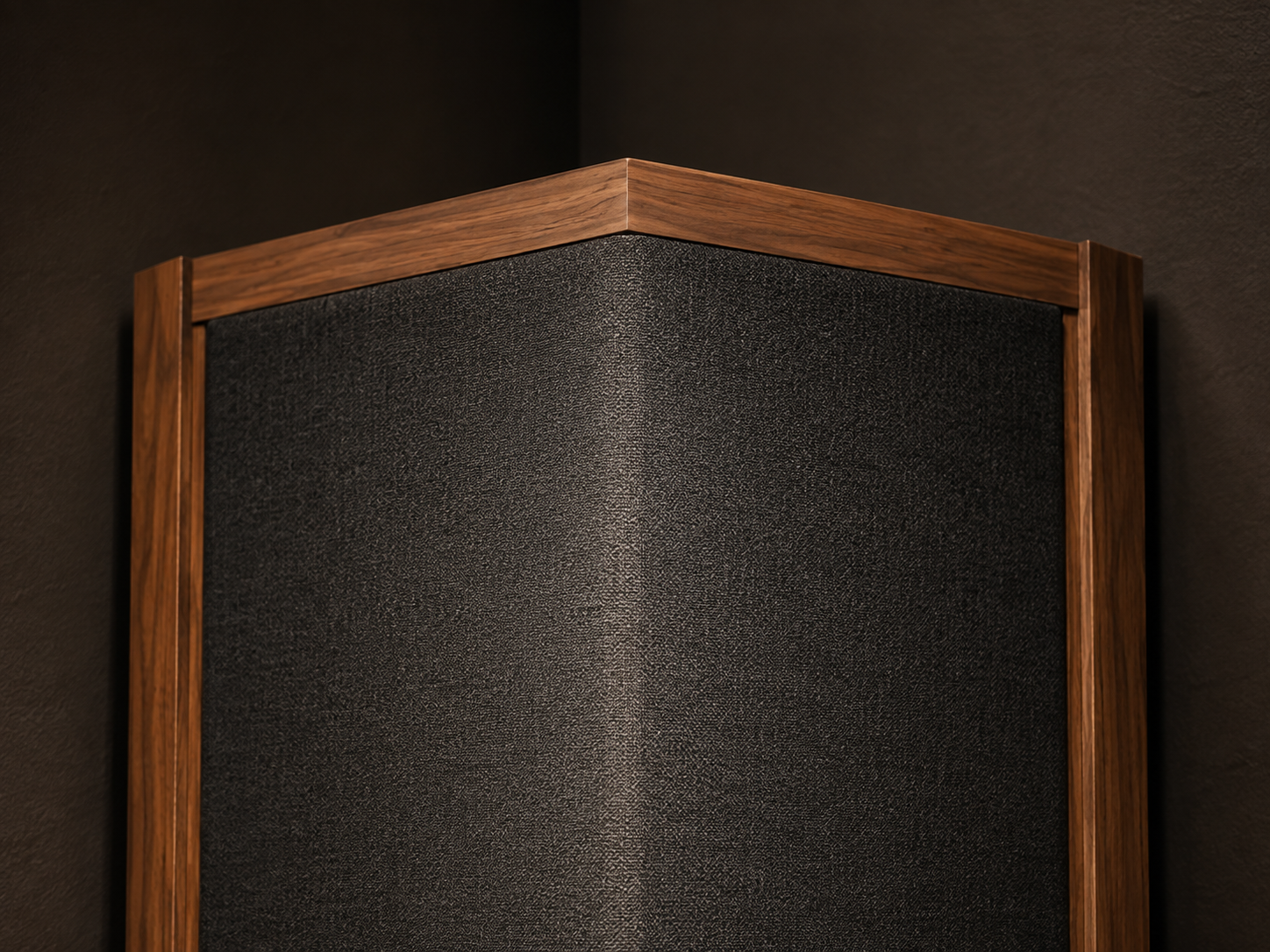
Large-volume construction · custom execution
CONSTRUCTION & MATERIALS
Volume, depth, and material as a coordinated system.
An effective bass measure requires significantly more volume and depth than a classic broadband absorber. Therefore, construction, absorption material, position, and possible air gaps are considered together and tailored to the specific room situation.
01 Stable frame construction
Twist-resistant frame for large-volume designs, clean edges, and a permanently stable execution.
02 Depth-effective absorption core
Porous absorption material with a construction tailored to depth, volume, and planned application area.
03 Acoustically open surface
Air-permeable covering in different colours, allowing sound energy to enter the absorption core as freely as possible.
04 Project-specific integration
Depending on the design, the bass trap can be floor-standing, stacked in a corner, mounted on a wall, or integrated into a custom room solution.
TECHNICAL EFFECT
More control over resonances and decay times.
The effectiveness of a bass trap depends on construction type, volume, depth, absorption material, and position in the room. Particularly room corners and areas with high sound pressure can be relevant for low-frequency measures. The appropriate solution should therefore be derived from measurement and room planning.
— Reduction of problematic low-frequency resonances
— Shortening of long decay times
— Project-specific positioning and dimensioning
Binding performance data will be published after final product testing and documented measurement.
SCHEMATIC LOW-FREQUENCY EFFECT

Schematic representation to explain the principle of operation. No tested product measurement data.
DESIGN & CUSTOMISATION
Bass control that integrates into the room.
Bass traps require more space due to their depth and volume than classic wall absorbers. Therefore, we coordinate the shape, fabric colour, wooden frame, and positioning so that the bass measure is technically effective and aesthetically harmoniously integrated.

01
Fabrics & colours
Acoustically open fabrics are available in different colours. This allows the bass trap to be discreetly adapted to the wall and furnishings or deliberately used as a design element.

02
Wooden frames & surfaces
Visible wooden frames give large-volume bass traps a high-quality architectural effect. Wood type, colour tone, and surface treatment are coordinated with the room concept.
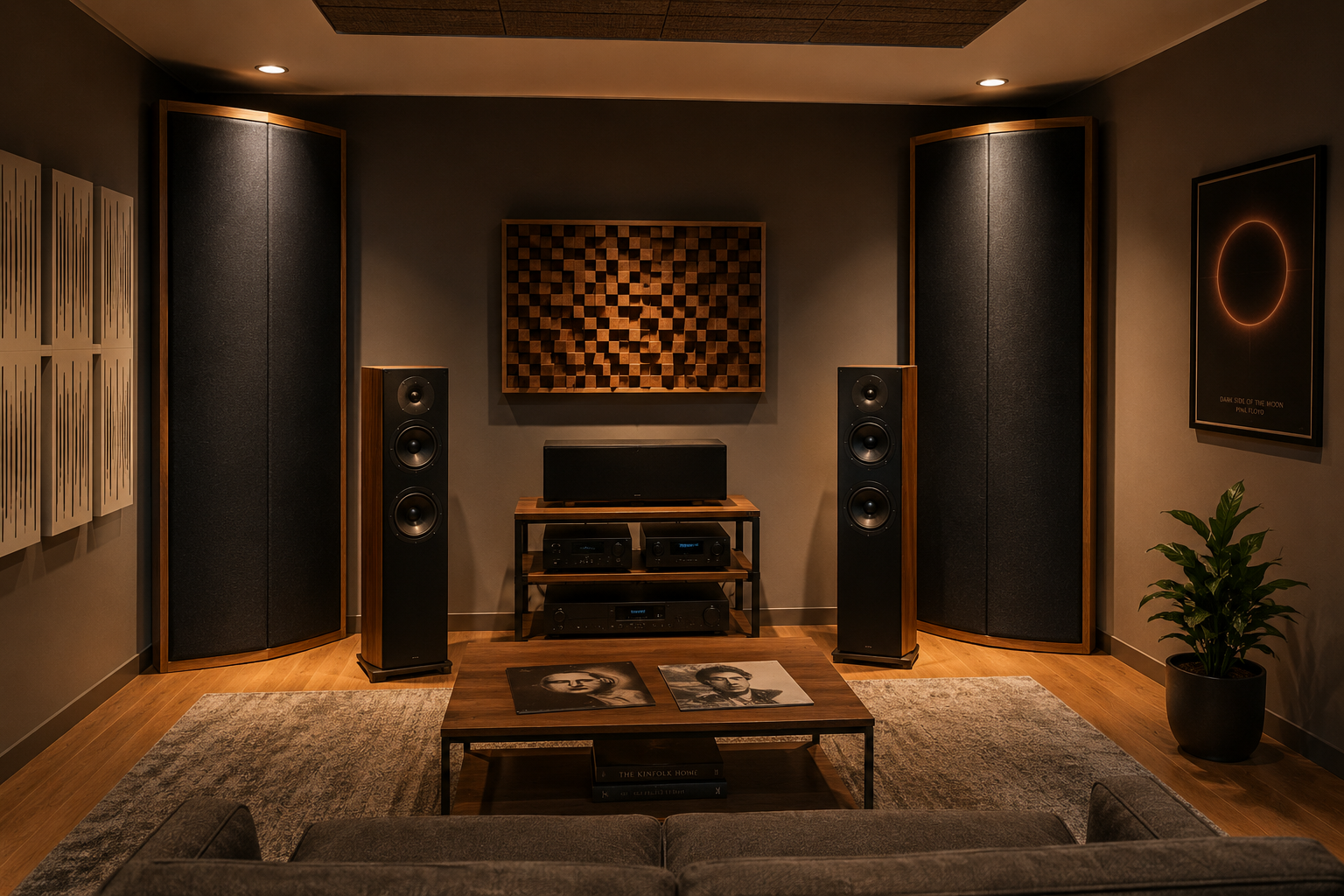
03
Custom design
For niches, sloped ceilings, low ceilings, or special corner areas, project-specific dimensions, modular solutions, and adapted mounting types are possible.
TYPICAL POSITIONING
Bass measures in acoustically relevant areas.
Bass traps are often used where low-frequency sound energy builds up particularly strongly. This includes room corners, transitions between wall and ceiling, as well as larger front or rear wall areas. However, the optimal position must be derived from room geometry, measurement, and speaker placement.
A large bass trap in the wrong place may be less effective than a precisely dimensioned solution in the right position. Therefore, we recommend an acoustic measurement or at least a project-specific plan before production.
01
Vertical room corners
Room corners are often relevant positions for large-volume bass traps, as multiple boundary surfaces meet there.
02
Front wall
Behind or next to the speakers, deep wall absorbers can be used to control resonances and reflections.
03
Rear Wall
On the rear wall, large-area and deep bass measures can reduce long decay times and reflections.
04
Wall-ceiling transitions
Horizontal transitions can also be used for bass measures when floor space or vertical room corners are not available.
FROM ANALYSIS TO BASS SOLUTION
A clear path to more controlled low frequencies.
Before production, we check the room, measurement data, available surfaces, and design requirements. Based on this, we determine suitable construction type, dimensions, positioning, and execution of the bass measure.
01
Room analysis
You send us room dimensions, photos, speaker positions, and existing measurement data. If necessary, we conduct an on-site measurement.
02
Design
We determine suitable positions, construction types, volumes, dimensions, and a sensible prioritisation of measures.
01
Manufacturing
The bass traps are manufactured according to the coordinated construction, covered, and prepared for the planned placement or mounting.
01
Delivery & installation
Depending on the project, the collection, delivery, or professional installation of the bass traps takes place directly in the room.
FAQ - FREQUENTLY ASKED QUESTIONS
Questions about RTA bass traps.
Here you will find answers to frequently asked questions about positioning, dimensioning, design, planning, and installation of our bass traps.
Where are bass traps typically positioned?
Common positions include vertical room corners, front and rear wall areas, as well as transitions between wall and ceiling. However, the optimal position depends on room geometry, speaker placement, and the measured resonances.
How large should a bass trap be?
Bass traps generally require significantly more volume and depth than classic broadband absorbers. The required dimensions depend on the room, frequency problems, available space, and desired effect.
Can a bass trap work down to 35 Hz?
Effective treatment of very low frequencies is generally possible, but requires significant volume, suitable construction, and correct positioning. A definitive statement about a specific frequency range is only possible after technical design and documented product measurement.
Is a single bass trap sufficient?
That depends on room size, problem frequencies, and the position of the bass trap. In many rooms, multiple measures or a combination of positioning, bass absorption, and electronic correction make sense.
Are different fabric colours and wooden frames possible?
Yes. The bass traps can be made with various acoustically open fabrics and optionally visible wooden frames. Available colours, wood types, and surfaces are tailored to the project.
Does Rock Tribe Audio also handle the installation?
Yes. We can take care of the professional positioning and installation of our own bass traps upon request. We do not install third-party products, as their construction, weight, and fastening systems have not been verified by us.
Can I only commission an acoustic measurement or planning?
Yes. You can also commission Rock Tribe Audio solely for acoustic measurement, evaluation, or bass planning. There is no obligation to purchase the recommended bass traps from us. However, we only offer installation for our own products.
CONTROLLED BASS FOR YOUR ROOM
Let us develop the right bass solution.
Send us information about your room, your speaker setup, and the perceived bass problems. We will clarify whether a measurement is sensible and which construction type, positioning, and execution suit your project.