
Using Diffusers Correctly
Diffusers scatter incoming sound in different directions. Unlike absorbers, they do not completely remove sound energy from the room.
When used correctly, they enhance spatiality, improve sound distribution, and create a more natural sound. Incorrect placement, on the other hand, can lead to uneven reflections and sound colouration.
What do diffusers do?
Smooth walls reflect sound back into the room in a concentrated manner. A diffuser, however, has surfaces of varying depths or irregular arrangements.
This results in the sound being distributed both temporally and spatially.
Possible advantages include:
- more spatial depth
- a wider stereo image
- fewer distracting individual reflections
- a livelier room sound
- a more even sound distribution
Diffusers do not automatically make a room quieter. They distribute existing reflections in a more controlled manner.
Diffuser or Absorber?
Absorbers and diffusers serve different purposes.
Absorbers reduce sound energy and shorten reverberation.
Diffusers retain some of the sound energy and distribute it throughout the room.
In small or highly reverberant rooms, it is advisable to start with broadband absorbers, bass traps, and Ceiling Clouds. Diffusers are then used to make the room sound more natural and less dry.
Diffusers do not replace bass traps. Low-frequency room modes can hardly be controlled with standard diffusers.
Where should diffusers be placed?
Rear Wall
The rear wall behind the listening position is a typical mounting location.
If there is sufficient distance between the listening position and the rear wall, a diffuser can break up strong direct reflections and improve spatial perception.
If the listening position is very close to the rear wall, a thick absorber is usually more suitable.
Side Walls
Broadband absorbers are usually used at the first reflection points in small studios.
In larger rooms, lateral diffusion can be beneficial to achieve more spatiality. The prerequisite is that there is enough distance between the diffuser and the listening position.
Recording Rooms
In recording rooms, diffusers help capture voices and instruments more naturally.
A combination of absorbers and diffusers prevents the room from sounding too dry. This is particularly advantageous for vocals, acoustic guitars, string instruments, and drums.
The Right Distance to the Diffuser
Diffusers require sufficient distance for the scattered sound to disperse in the room.
As a rough guide, there should be at least about 1,5 to 2 metres between the diffuser and the listening position. For deep or particularly large diffusers, a greater distance may be necessary.
The exact minimum distance depends on the design, depth, and effective frequency range of the diffuser.
What types of diffusers are there?
QRD Diffusers
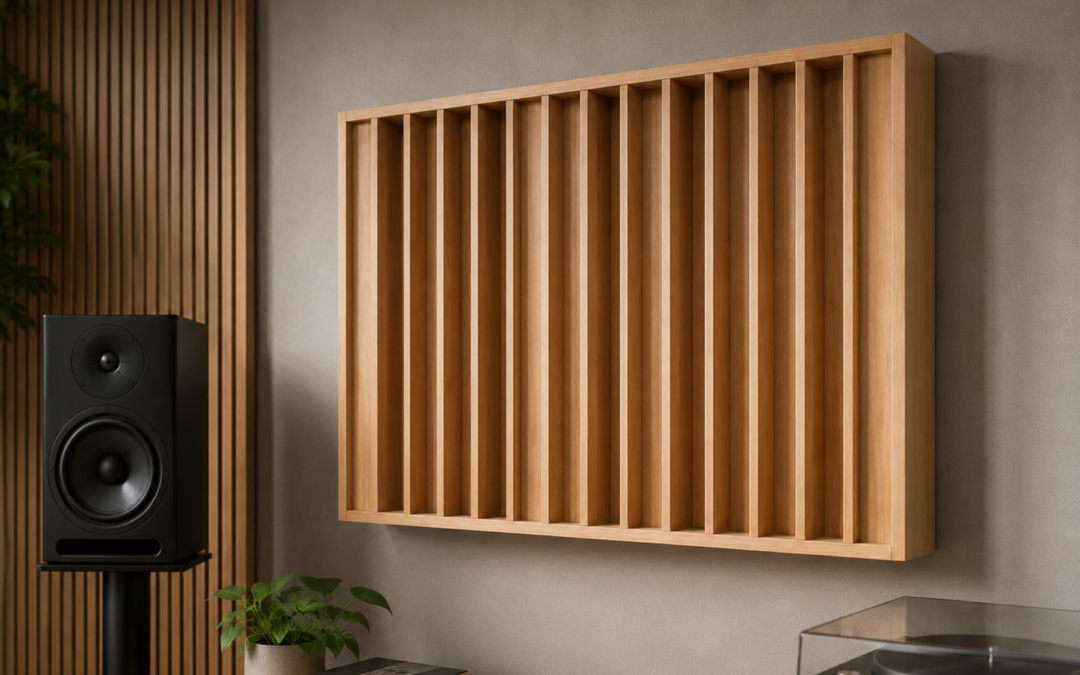
QRD diffusers consist of shafts of varying depths. Their arrangement is mathematically calculated.
They primarily scatter sound in one direction and are commonly used in recording studios and high-quality listening rooms.
Skyline Diffusers
Skyline diffusers feature wooden elements of varying heights. They distribute sound both horizontally and vertically.
They are particularly suitable for larger wall or ceiling surfaces.
Hybrid Absorbers
Hybrid absorbers combine absorption and sound scattering.
Behind a slotted or structured wooden surface, there is absorbent material. This allows part of the sound to be absorbed while another part is reflected or scattered.
This design is particularly well-suited for smaller rooms.
Common Mistakes
Diffusers should not be used without an overall acoustic concept.
Typical mistakes include:
- too little distance to the listening position
- using diffusers as a substitute for bass traps
- installation in highly reverberant rooms
- too small treated areas
- selection based solely on design
- positioning without measurement or analysis
Not every decorative wooden panel is a technically effective diffuser. The dimensions, construction depth, and calculated frequency range are crucial.
Combining Absorbers and Diffusers
In a balanced room acoustics concept, both solutions are combined.
A typical arrangement may consist of the following elements:
- Bass traps in the room corners
- Broadband absorbers at the first reflection points
- Ceiling Clouds above the listening position
- Absorbers or hybrid modules on the front wall
- Diffusers or deep absorbers on the rear wall
Which solution is optimal depends on the room size, usage, and existing acoustic problems.
Conclusion
Diffusers can improve the spaciousness, clarity, and naturalness of a room. The prerequisites are the correct position, sufficient listening distance, and already controlled basic acoustics.
In small rooms, absorbers and bass traps usually take precedence. Diffusers should then be used strategically to keep the room lively and distribute reflections more evenly.
Professionally Planning Room Acoustics
Are you unsure whether diffusers, absorbers, or bass traps are suitable for your room?
Rock Tribe Audio supports you with acoustic measurement, planning, and optimisation of recording studios, music rooms, home cinemas, offices, and living spaces.
Get your room acoustics analysed now
Frequently Asked Questions about Diffusers
Where should a diffuser be placed?
Diffusers are often used on the rear wall of a listening room or recording studio. In larger rooms, they can also be used on side walls, ceilings, or in recording spaces. The optimal position depends on the room size and listening position.
How far should you sit from a diffuser?
As a rough guideline, a distance of at least 1,5 to 2 metres is recommended. Deeper diffusers may require a greater distance.
Are diffusers suitable for small rooms?
In small rooms, absorbers are usually more important. Flat diffusers or hybrid absorbers can, however, be sensible if the reverberation time is already adequately controlled.
Do I need absorbers and diffusers?
In most professionally treated rooms, both elements are combined. Absorbers reduce distracting reflections and reverberation, while diffusers evenly distribute the remaining sound in the room.
Do diffusers help with bass problems?
Standard diffusers hardly help with low-frequency room modes. For bass issues, bass traps, optimised speaker placement, and possibly electronic room correction are needed.
What is the difference between a diffuser and an acoustic panel?
A diffuser scatters sound purposefully. A classic acoustic panel primarily absorbs sound energy. Decorative wooden panels may scatter to some extent, but they are not automatically calculated diffusers.